
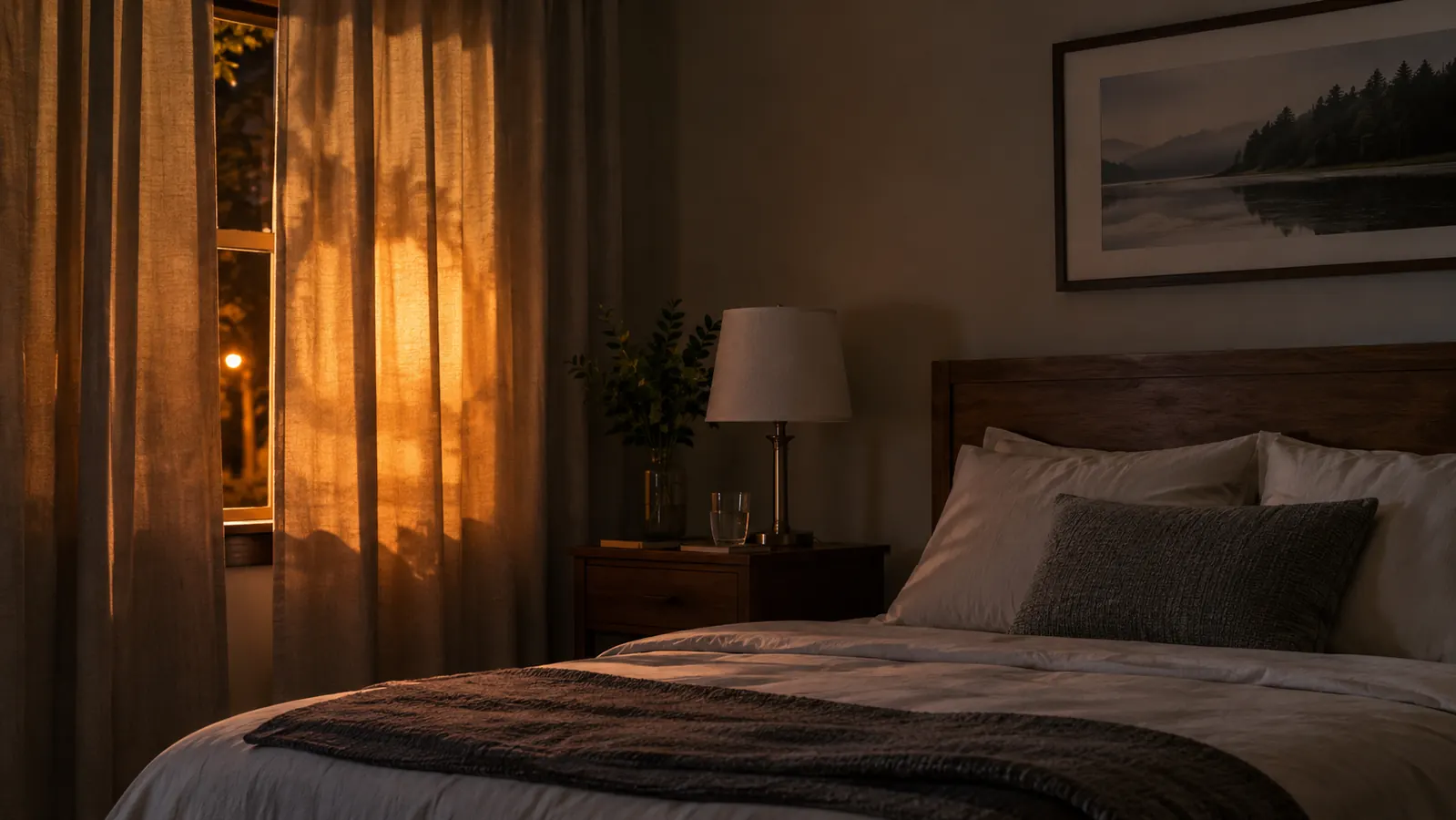
For about three years, my nights ran on a schedule I did not set. I would fall asleep fine around ten, then wake at three, and lie there for an hour or more listening to the street lamp hum through the window on my side of the bed. I told myself it was just what happens in your sixties. Then I started paying attention to what actually woke me, and nine times out of ten it was light. The lamp outside. The little green dot on the smoke detector. The clock face. The strip under the bedroom door. That is when I bought the MZOO sleep mask, along with a few other things, in the first week of March, with my own money. Eight months later it is the one item on my nightstand I would replace the same day if it broke.
Before that I tried the obvious things. I folded a t-shirt over my eyes. I draped a towel across the curtain rod, which fell down twice and once landed on Dale. I bought a plain silk eye mask and wore it for about a year, and it let light in at the nose and slid off every time I turned onto my side. None of that was wasted time, exactly. It taught me that the problem was never that I needed a mask. The problem was that light was getting in through four or five different gaps, and one thin piece of fabric across my eyes was never going to close all of them. What follows is the order I would do it in if I were starting over tonight.
The street lamp was my biggest problem. This is what finally closed it.
Contoured memory foam with 13mm eye cups and 22mm nose padding, an adjustable buckle strap, and a hand wash only care routine. Eight months of nightly use on my nightstand.
Amazon Check Today's Price on Amazon →Step 1: Find every place light actually reaches your face
Before I bought anything, I did one thing that made everything else easier. I wrote down every light source I could see from my side of the bed, on paper, at three in the morning, which is when you can actually see them. I counted seven. The street lamp through the window, obviously. The green dot on the smoke detector. The blue digits on Dale's clock radio. A tiny light on the charging cable plugged in beside my nightstand. The gap under the bedroom door where the hallway light spills through. The alarm clock face. And a sliver of window above the blind that I had never once noticed in the daytime.
That list matters because it changes what you are shopping for. If you have one light source, almost any decent mask will do. If you have seven, and one of them is coming in low from below, you need something that seals rather than something that covers. A flat piece of fabric across the eyes covers. It does not seal. That is the difference between a mask that works and a mask you pull off at 3:20 in the morning without remembering doing it.
Do this audit on a night when you are already awake anyway. Keep the pad of paper on the nightstand, write down what you see, then turn your head to the left and to the right and notice what new light appears. Side sleepers see different gaps than back sleepers do, and that last part turned out to matter more than I expected.
Step 2: Close the light at the source before you close it at your face
This is the unglamorous half of the job, and it is the half most people skip.
The street lamp was my largest problem, so it is where I started. I pulled the curtains properly closed instead of leaving that hand-width gap, and I overlapped the two panels instead of letting them meet edge to edge. I rolled a small towel and pushed it along the windowsill where the light came in under the hem. That alone cut the room down enough that I could tell the difference on the first night.
The rest was smaller and just as irritating. A square of electrical tape over the green dot on the smoke detector. The clock radio turned to face the wall. The phone moved out to the kitchen to charge overnight, which also stopped me from looking at it at three in the morning, and honestly that was worth as much as the darkness. A folded towel along the bottom of the bedroom door to block the hall light. None of it cost anything and all of it stays done. But it does not finish the job, because the window on my side of the bed faces a lamp that comes on at dusk and stays on until morning, and no curtain I own closes that completely. That is what the mask is for.
Step 3: Choose a mask that seals at the nose and the cheekbones, not just across the eyes
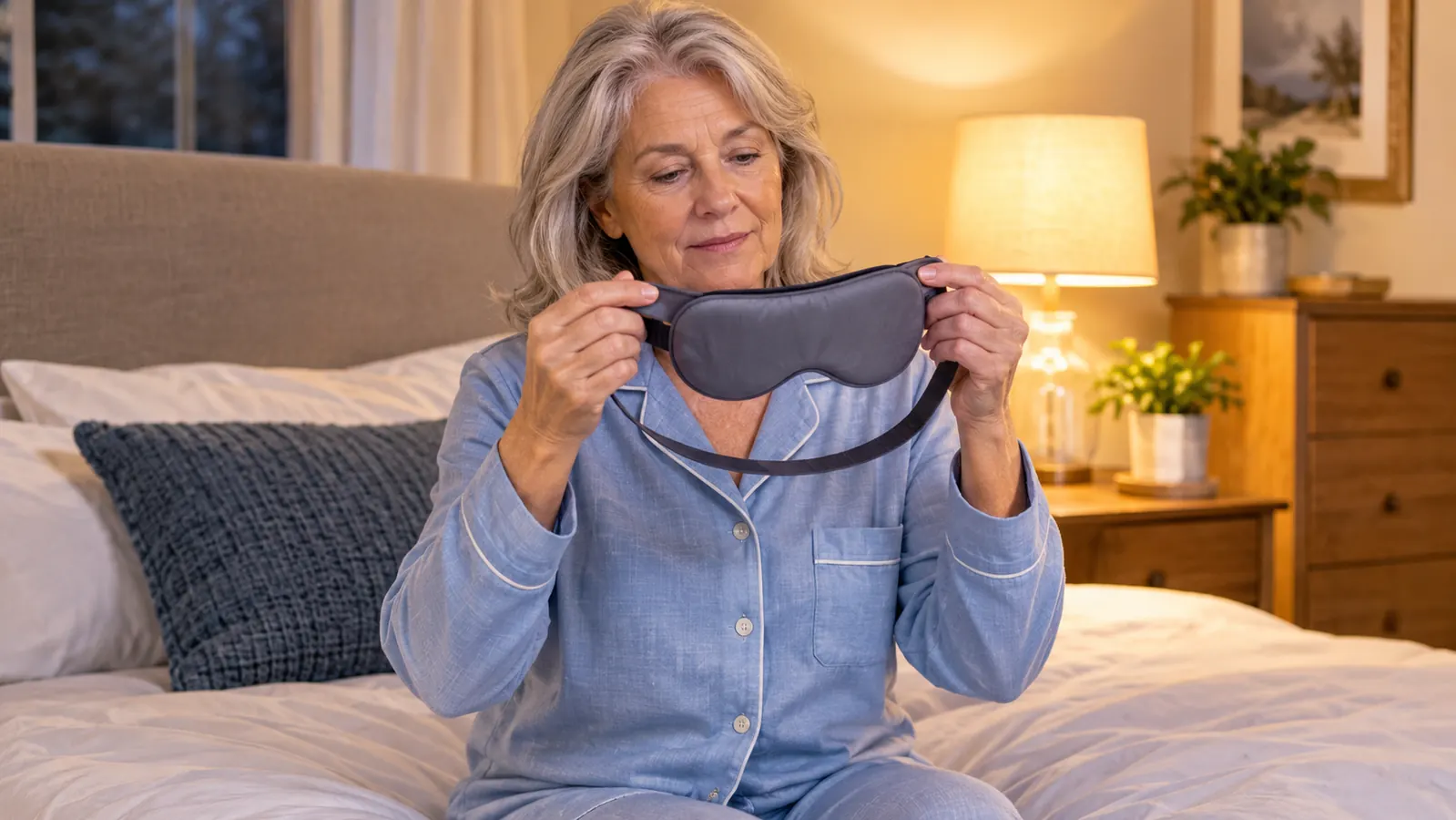
Here is where a contoured mask differs from the flat silk one I used for a year. The MZOO is low-rebound memory foam, shaped so the eye area is a cup rather than a flat panel. The eye cups are 13mm deep and widened, which means your lashes have somewhere to go and you can blink and even open your eyes behind it without your lids touching fabric. The nose piece is 22mm of padding, and that is the part that matters if light leaks in at the nose the way it did with my silk mask. The sides are curved at 15 degrees and thinned down, so when you roll onto your side there is not a bulge pressing into your temple. The strap closes with a buckle and it adjusts.
It measures 10 by 3.9 by 0.78 inches and weighs 4.94 ounces. That is light enough that I stopped noticing it after about a week, and substantial enough that it does not ride up onto my forehead when I turn over.
Whatever brand you end up with, check one thing before you buy: does it seal under the eyes and across the bridge of the nose, or does it simply rest there? My silk mask failed on both counts. The MZOO seals on both, and the practical result at three in the morning is that I no longer see the street lamp at all.

Step 4: Fit it properly, then give it a week before you judge it
A new mask is not comfortable on night one. I want to be honest about that, because I nearly gave up on mine.
Set the strap first, sitting up, in ordinary room light. Loosen it, put the mask on, then tighten the buckle one notch at a time until it seals without pressing. If you can feel your pulse in your temples, it is too tight, and a mask that is too tight will wake you at two in the morning just as reliably as light will. If it shifts when you turn your head, it is too loose. The sweet spot is narrower than you would think and it takes a few tries to find.
Then give it a full week. The first three nights I was very aware of something on my face and I slept worse, not better. By night six or seven I put it on and stopped thinking about it. That is normal, and most people quit on night two and decide masks do not work for them.
Care is the last piece, and it is where these things get ruined. This one is hand wash only. I wash mine about every two weeks in the bathroom sink with a little mild soap and lukewarm water, rinse it well, press the water out with a towel rather than wringing it, and leave it flat to air dry. No washing machine, no dryer. Memory foam does not come back from either one. During the day it lives on my nightstand, which is also a decent reminder to actually wash it.
Step 5: Take some of the weight off the mask
Once the light is handled, the mask stops being the entire plan and becomes one part of it, which is how it should be.
My evenings have not changed much in thirty years, but the last hour has. I am off screens earlier. The thermostat goes to 67 at night and stays there, so the room is as cool as I can reasonably make it, and that is deliberate, because a warm bedroom was one of the three things I identified as waking me. Dale's light snoring is the second, and a white noise machine on my nightstand handles that without me shoving him. The third was light, and that is the mask.
The point is not to buy five things. The point is that a mask works best when it is not fighting the room. If the bedroom is eighty degrees, the hallway light is on and your phone is buzzing on the nightstand, a mask cannot carry all of that, and you will blame the mask.
What Else Helps
Two other things earned their place on my nightstand over these eight months, and I would mention them even if nobody asked.
The first is sound. If the person next to you snores, or a car goes past at four in the morning, blocking the light will not be enough on its own. A white noise machine running brown noise all night, about a third of the way up the volume and set to stay on rather than on a timer, covers the small stuff without becoming its own nuisance. I had used an old box fan for years and never realized how much of my 3am waking was the fan itself cycling. It took two or three nights before I stopped noticing the machine, which is about the same adjustment period as the mask.
The second is temperature at your head, not just in the room. I swapped a flat polyester pillow for a shredded memory foam one with a cool side and felt the difference in the first week, mostly in how often I was flipping it over in the dark. It does warm up. I will not pretend otherwise. But it starts cool, and starting cool is most of the job at three in the morning.
The third, if you want one, is how you wake up. I moved to a sunrise clock and put the phone in the kitchen overnight. That is a morning problem more than a night problem, and I will say plainly that wearing a mask means I often sleep through the light part of the sunrise and wake to the birdsong at the end of it. On the mornings I have already pushed the mask up onto my forehead, the light does the work. Either way, I am not waking to a phone buzzing on the nightstand, and that alone changed the mood of the morning.
I counted seven light sources from my side of the bed at three in the morning. The street lamp was only one of them.
When to Stop Rearranging the Bedroom and Talk to Someone
I am not a doctor and I am not going to pretend a sleep mask is a treatment for anything. What I did was make my bedroom darker, cooler and quieter, and it helped. I still wake some nights. Usually it is once, and I am back asleep in about twenty minutes instead of an hour, and that is a real improvement in my life without being a cure for anything.
But if you are waking most nights for weeks on end, or if you are snoring heavily, or if you are falling asleep during the day without meaning to, please go talk to your doctor. There are causes of poor sleep that no product on a nightstand will touch, and there is no shame in asking. That is what I would tell my sister, and it is what I am telling you.
If you are going to start somewhere, start with the light that wakes you.
Eight months of nightly use, one hand wash every two weeks, still the first thing I reach for. Contoured memory foam, adjustable buckle strap, 3D eye cups.
Amazon See the MZOO Sleep Mask on Amazon →